A mayor cannot change your mortgage rate, but City Hall can still change what home you can afford.
Table of Contents
What the Mayor Can and Cannot Control
Toronto voters choose their next mayor on October 26, 2026. Mortgage rates are primarily influenced by financial markets, lender funding costs and monetary policy. Federal mortgage rules also play a major role in qualification. Toronto’s mayor does not control any of those things.
But the City does influence property taxes, Toronto’s Municipal Land Transfer Tax, development charges, zoning, building approvals and housing programs. Those decisions can change the amount of cash a buyer needs, the monthly carrying cost of a property and, over time, the number of homes available. That distinction is important because a municipal election may not change the interest rate printed on your mortgage commitment, but it can still change the economics of your mortgage. For those purchasing a new home or considering mortgage refinancing options, these costs can be very important.

Land Transfer Tax
Toronto buyers can face both Ontario land transfer tax and a separate Toronto Municipal Land Transfer Tax when purchasing a property. Remember that land transfer taxes can differ significantly by province.
One proposal by a mayoral candidate was to eliminate Toronto’s Municipal Land Transfer Tax on the first $1.1 million of a qualifying principal-residence purchase. The proposal estimates that a buyer purchasing at that threshold could save about $18,000 in Toronto land transfer tax. This is a campaign proposal, not current law.
That would not increase your income or lower your mortgage rate. It could, however, reduce the amount of cash required to close a purchase. For a buyer saving cash for a down payment, that distinction matters. It becomes particularly important for buyers who are putting down less than 20%, which is a high-ratio mortgage.

Property Taxes
Property tax is not merely a bill that arrives after you buy the home. It can be part of the mortgage qualification calculation itself. The Financial Consumer Agency of Canada (FCAC) explains that mortgage housing costs used in the Gross Debt Service calculation include mortgage payments, property taxes, heating costs and, where applicable, part of condominium fees. Don’t forget, your credit score affects your mortgage.
That means higher property taxes can push a borrower’s housing ratio higher. Depending on the rest of the application, that can reduce borrowing room. Toronto’s adopted 2026 budget included a combined residential property-tax and City Building Fund levy increase of 2.2%.
According to the City, that represented about $91.53 per year on the average assessed Toronto home used in its budget example. Some mayoral candidates have said they would freeze property taxes. Provincial separation debates can affect the broader mortgage landscape because property-tax systems vary across Canada.
Housing Supply and Prices
The less immediate — but potentially larger — mortgage connection is housing supply. Municipal decisions affect where housing can be built, what type of housing can be built, how quickly projects are approved and some of the charges developers pay. Those policies can influence whether projects proceed and how much new supply reaches the market. Additionally, municipalities are trying to lower housing costs through policy.
Toronto has already moved significantly on development charges. In 2026, the City approved time-limited reductions of 40% for smaller residential units and 60% for larger units, backed by up to $1.5 billion in federal-provincial infrastructure funding. The City says the reductions are intended to improve project viability and support more housing supply.
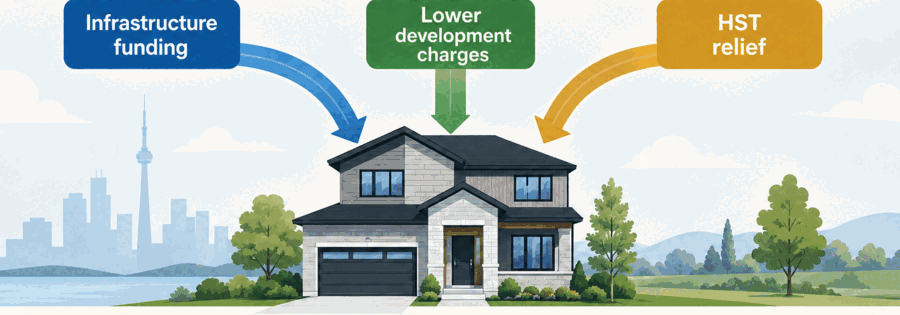
If municipal policy increases new housing builds, this additional supply could reduce housing prices over time. That does not mean a particular policy will automatically make Toronto homes cheaper; interest rates, population growth, construction costs, incomes and the wider economy also influence prices.
A lower purchase price changes the mortgage directly. It can reduce the required loan amount, down payment and monthly payment. It also changes the loan-to-value ratio used in financing.

How Homebuyers Are Affected
If you’re thinking of moving to a different province, be aware of how interprovincial relationships can affect mortgages.
A first-time buyer may care most about the cash required at closing. An existing homeowner moving within Toronto may focus on both land transfer tax and the cost of the next property. A condo buyer may be watching property taxes and condo fees. An investor may care more about property taxes, municipal fees, rental policy and the ability to add or redevelop housing.
The effect can also differ by borrower. Someone with very low GDS/TDS ratios may barely notice a modest property-tax change. Someone whose ratios are already high may care about every additional monthly housing cost. And don’t forget, you can also change the amortization period.
This is why mortgage qualification should not be viewed only through the interest rate. Income, debt, property taxes, down payment and the property itself all interact.
A Mortgage Question Toronto Voters May Ask
Toronto’s mayor cannot promise you a lower five-year fixed mortgage rate. But the mayor and City Council can make decisions that affect closing costs, property taxes, housing supply and the total cost of owning a home.
So instead of asking only, “Which candidate will make housing cheaper?” a mortgage-focused voter might ask a more precise question: Which municipal policies will affect the cost and my ability to qualify for a mortgage?
Those numbers can matter long before the first mortgage payment is ever made.
Toronto’s municipal election is on Monday, October 26, 2026. Official Toronto Elections information.