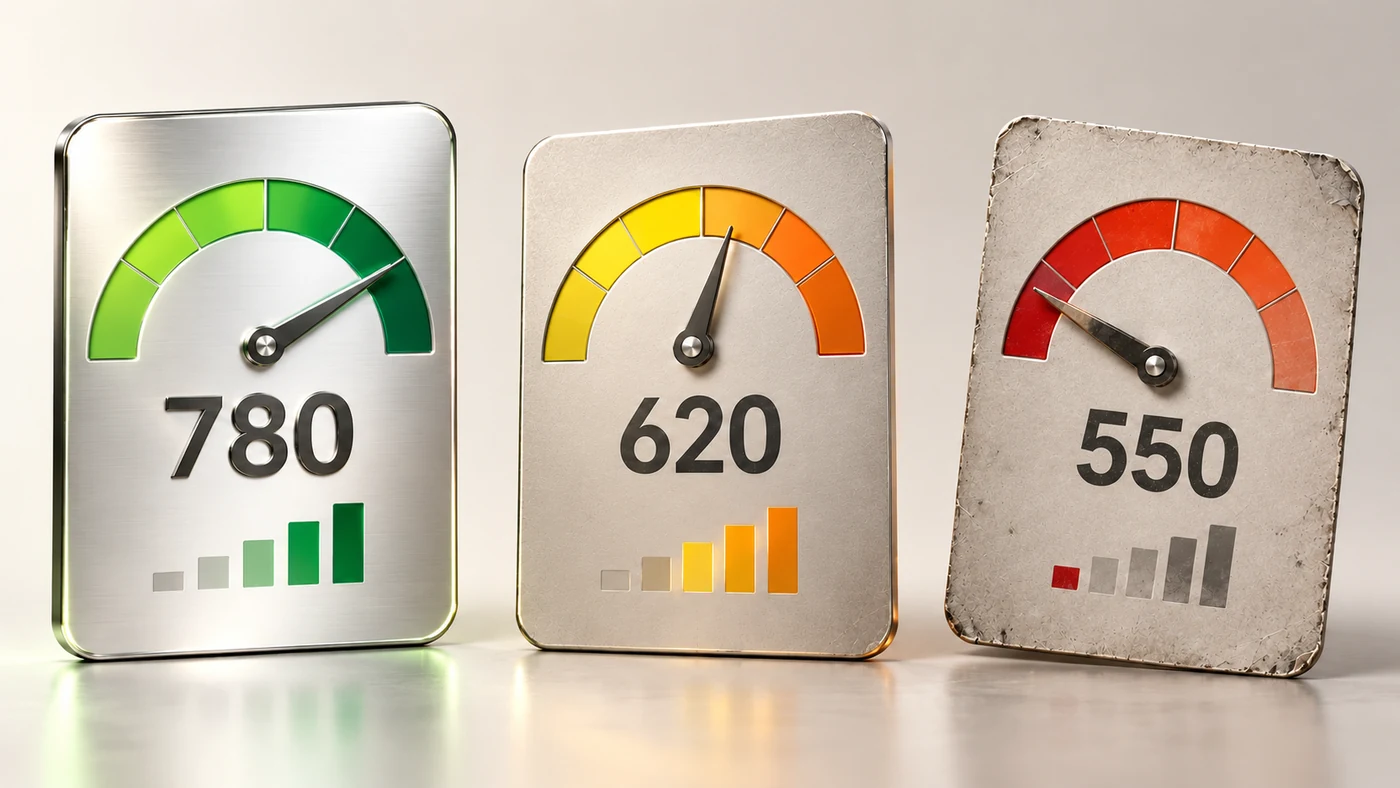
Your credit score can make or break your mortgage approval.
Table of Contents
How Lenders Read Credit Scores
Your credit score itself does not change from province to province; a 680 remains a 680, although individual lender policies can differ. For more on how mortgage rules and financial systems can vary across provincial borders, see Interprovincial Trade Barriers & Mortgages.
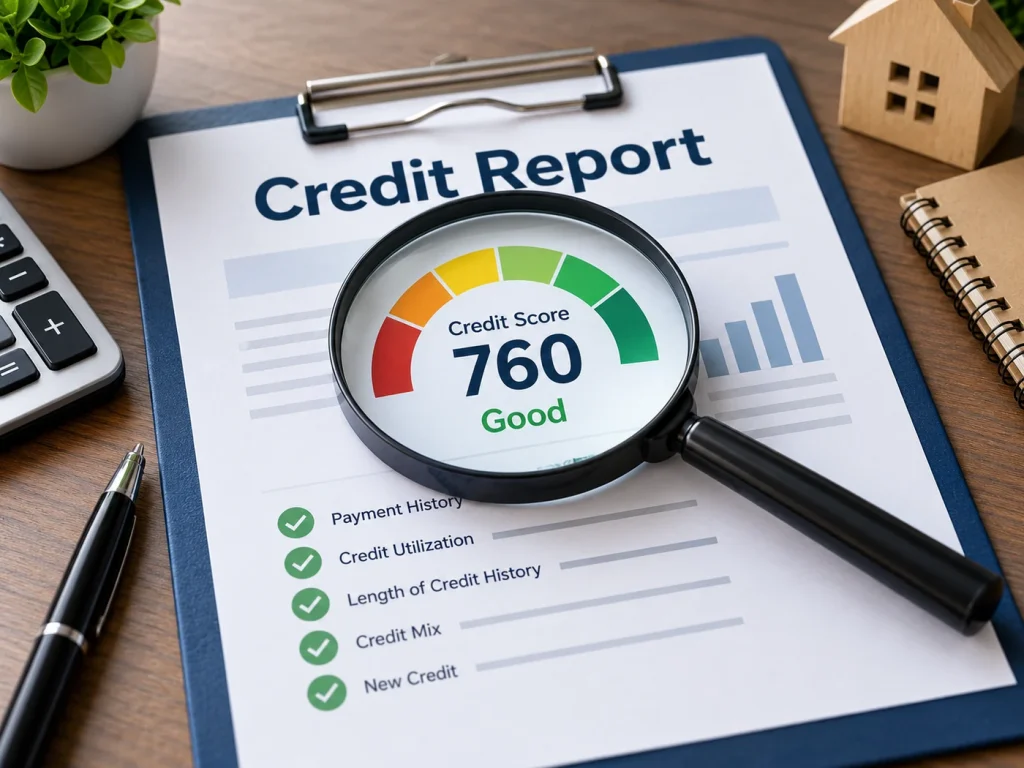
Your credit score is one way a lender measures the risk of lending you money. A higher score generally indicates that you have a stronger history of managing credit and making payments as agreed, while a lower score tells the lender that there may be more risk.
But your credit score is not looked at by itself. A lender will also consider things such as your income, debts, employment, down payment, the property you are buying and your overall credit history. If you are a non-Canadian applying for a mortgage, you may also be asked to provide credit history from your country of origin; read more in Mortgage Challenges for Non-Canadians.
Credit Score 680 or Higher
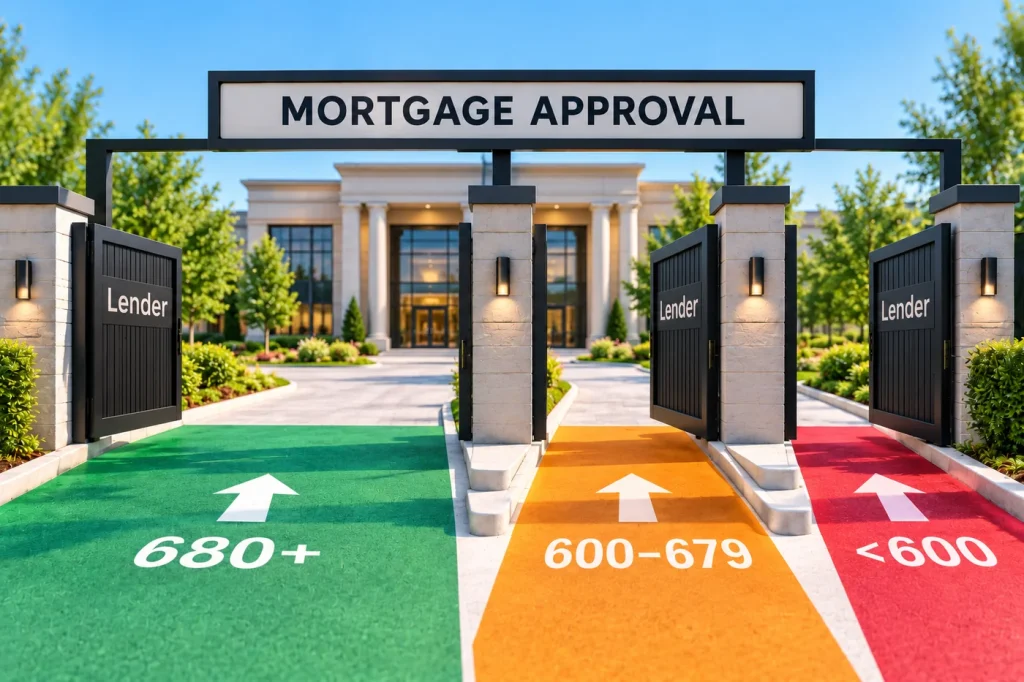
Once your credit score is around 680 or higher, you will generally have access to the widest range of mortgage options, including more lenders, lower mortgage rates, higher allowable loan-to-value and more flexibility in the mortgage application. This is where many borrowers begin to fit comfortably within what we commonly call A-lender or prime lending.
For borrowers purchasing with less than 20% down, mortgage default insurance may allow financing of up to 95% of the home’s value, subject to the mortgage insurer’s and lender’s other qualification requirements. This is commonly known as a high-ratio mortgage.
A high credit score does not automatically guarantee approval or the lowest rate, because the rest of the mortgage application still has to qualify.
Credit Score 600 to 680
A credit score between approximately 600 and 680 can still provide access to mortgage financing, but the number of available lenders may begin to narrow.
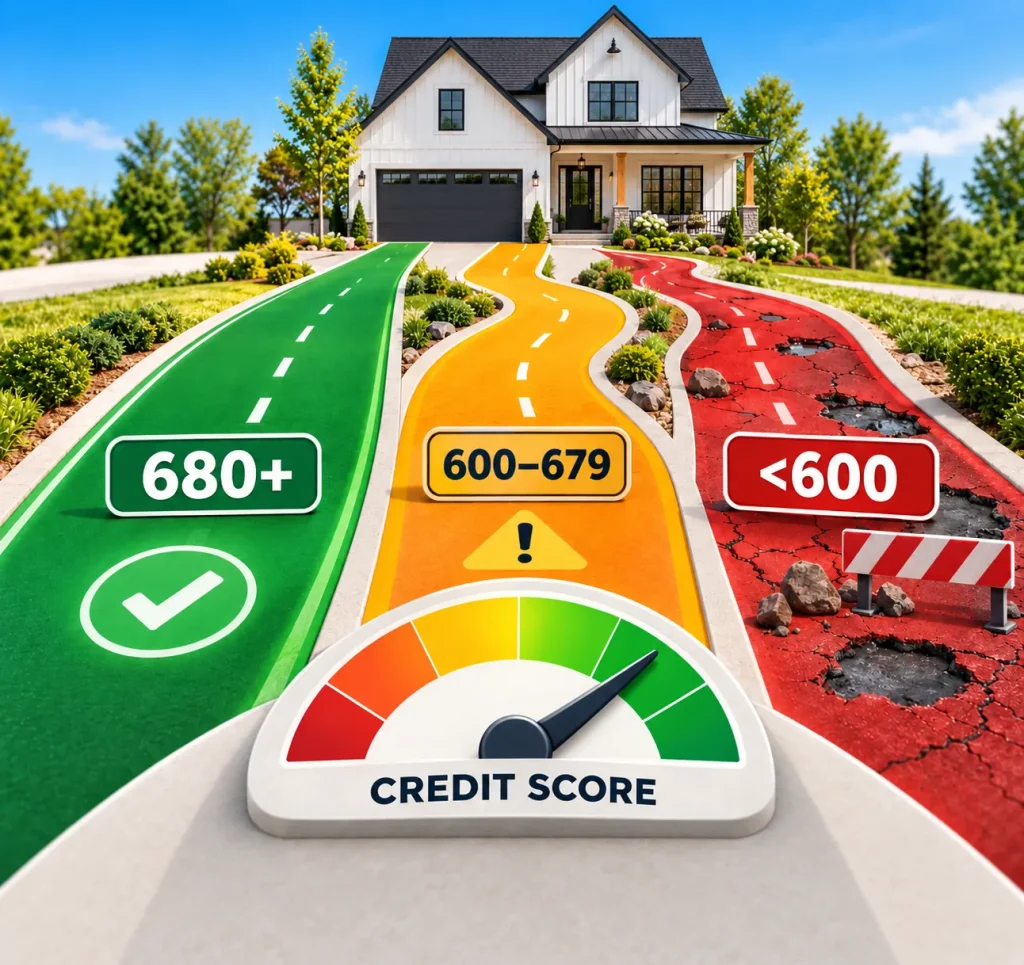
You may not have access to every A lender, and the lender may look more closely at the rest of your application. You may also face a higher interest rate, less flexibility, or a requirement for a stronger overall application.
For example, a borrower with a 640 credit score, strong income, low debt and a substantial down payment may be viewed very differently from someone with the same credit score who also has high debt and recent missed payments.
A score below 680 does not automatically eliminate the possibility of a high-ratio mortgage. A score of 600 can still be sufficient for certain insured mortgage programs, depending on the rest of the application.
So while 600 is an important threshold, the credit score still has to be considered together with the borrower’s income, debts, down payment and overall credit history.
Credit Score Less Than 600
Once your credit score falls below approximately 600, obtaining a traditional prime mortgage generally becomes much more difficult. This is where we may begin looking at what are commonly called alternative lenders, sometimes referred to as B lenders. These lenders are designed for borrowers who may not fit traditional bank guidelines because of credit problems, unusual income, previous bankruptcies, consumer proposals or other circumstances.
The trade-off is usually cost. Alternative lenders will generally charge a higher mortgage rate than the strongest A lenders and frequently require significantly more equity in the property.
In many situations, that means the borrower needs approximately 20% down or more. A lower credit score can also reduce the maximum loan-to-value a lender is willing to offer. Because an uninsured conventional mortgage generally cannot exceed 80% loan-to-value without mortgage default insurance, losing access to insured financing can dramatically change how much cash a borrower needs to purchase a property.
For some borrowers, the next step may be to look at private lenders or consider whether mortgage refinancing could provide another path. Which option makes sense depends on the borrower’s equity, income and overall credit situation. Credit becomes even more important when refinancing a rural property, because fewer lenders may be willing to finance certain rural properties in the first place.
How Credit Scores Affect Mortgage Rates
Credit risk also affects pricing. Generally, the stronger the borrower and the mortgage application, the more competition there is among lenders for that mortgage, which usually gives the borrower access to better rates.
As the perceived risk increases, the mortgage rate generally increases as well. This is particularly noticeable when moving from an A lender into the alternative lending market.
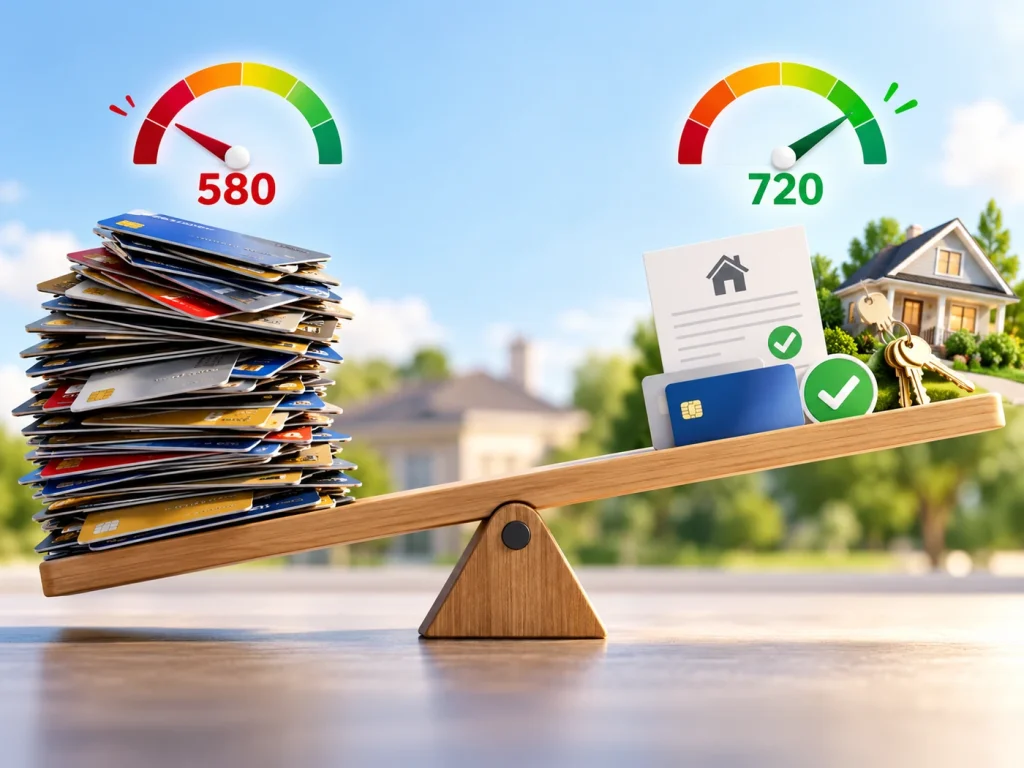
You could therefore have two people buying identical houses with identical incomes but paying very different mortgage rates because the risk profile of the two applications is different.
Challenged Credit and Private Lenders
If a borrower cannot qualify with either an A lender or an alternative lender, a private mortgage may sometimes be considered. Private lending is a very different market, and the lender is often far more concerned about the amount of equity in the property than about whether the borrower fits traditional bank guidelines.
The important thing to understand for this discussion is simple: private mortgages can be extremely expensive compared with traditional mortgage financing. In some cases, borrowers with challenged credit are also carrying high-interest debt, which is why debt consolidation may become part of the broader conversation. If serious credit problems are happening at the same time as missed mortgage payments, there may also be ways to stop a power of sale before the situation gets worse.
They are generally something I would look at only after understanding why the borrower cannot qualify for less expensive financing and whether there is a realistic plan to eventually move the mortgage back to a traditional lender.
Why Credit Scores Matter
A strong credit history can also give you more options if your employment situation suddenly changes, although income still matters for mortgage qualification. If that happens, read I Lost My Job. What Happens to My Mortgage?
Your credit score is probably one of the most important pieces of information a lender looks at when reviewing a mortgage application. Income matters, your down payment matters and the property matters, but a very high income does not necessarily overcome poor credit. Credit is only one part of qualifying; the mortgage stress test also looks at GDS and TDS debt ratios to determine how much mortgage you can afford.
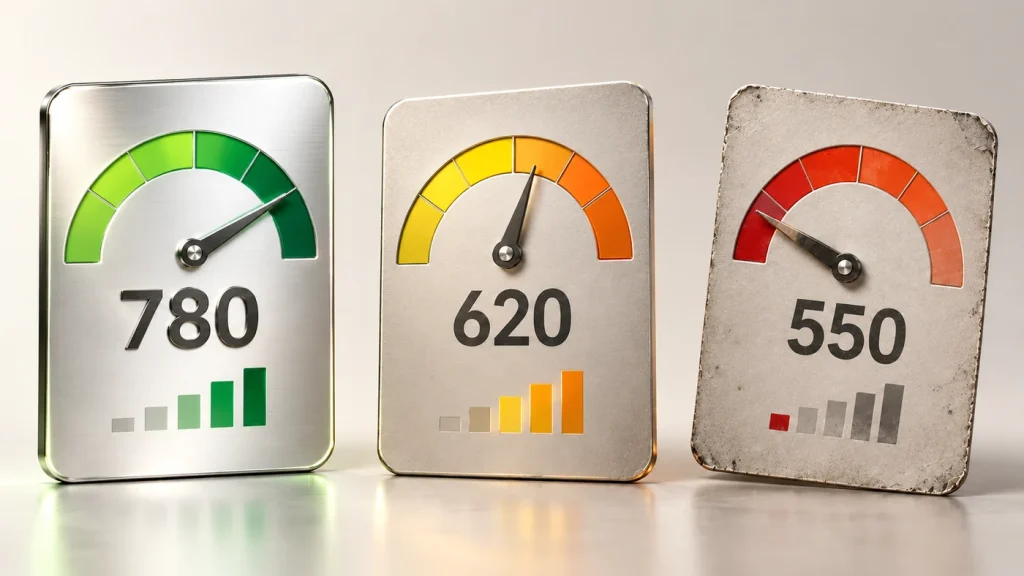
You could earn hundreds of thousands of dollars per year, but if your credit history shows that you have not managed borrowed money well, many traditional lenders may still refuse the mortgage.
From the lender’s perspective, the question is not simply “Can this person afford the mortgage?” It is also “Based on their history, how likely are they to repay money as agreed.” That is why credit can have such a powerful effect on whether you are approved, which lenders are available to you, your maximum loan-to-value and the interest rate you receive.
Improving Your Credit Score
The good news is that a credit score is not necessarily permanent. There are steps borrowers can take to improve their credit profile over time.
Because improving your credit score is such an interesting and complex subject, we’ll leave that for another article. If your score is preventing you from getting the mortgage you want, improving your credit may open up more lender options and potentially reduce your borrowing costs. For some borrowers, reducing high-interest balances through debt consolidation may also be worth exploring as part of a broader credit-improvement plan.
The Bottom Line
The easiest way to understand credit scores and mortgages is to think of them as a sliding scale.
Strong credit: More lender choices, potentially higher loan-to-value and usually access to the most competitive rates.
Mid-range credit: Fewer lender choices, more scrutiny and potentially higher rates.
Weak credit: Alternative lenders may be required, the allowable loan-to-value may fall and borrowing costs can rise significantly.
And if the application eventually requires private financing, the cost can increase substantially again.