You can earn a lot of money and still have a bank tell you that you don’t earn enough.
You might earn $100,000 a year, but a lender may not use all of it. Before deciding how much mortgage you can afford, the bank first decides how much of your income it will recognize. The type of income matters.
Table of Contents
Salaried Income
For a salaried employee, income is usually the simplest to verify. A lender will commonly review documents such as an employment letter, recent pay stub and T4, and in some cases a T1 General or Notice of Assessment. Your T4 income is reported to the CRA and ultimately forms part of the income reported on your personal tax return.
The lender is trying to answer three basic questions: How much do you earn? Is it stable? Is it likely to continue?
For a borrower with a stable salaried job, good credit and an otherwise strong application, this is generally the type of income that gives access to the widest range of lenders and potentially the lowest mortgage rates. But even strong income cannot insulate you from broader rate changes, so it is worth following Bank of Canada rate decisions when thinking about affordability.
Not All Employment Income Is Equal
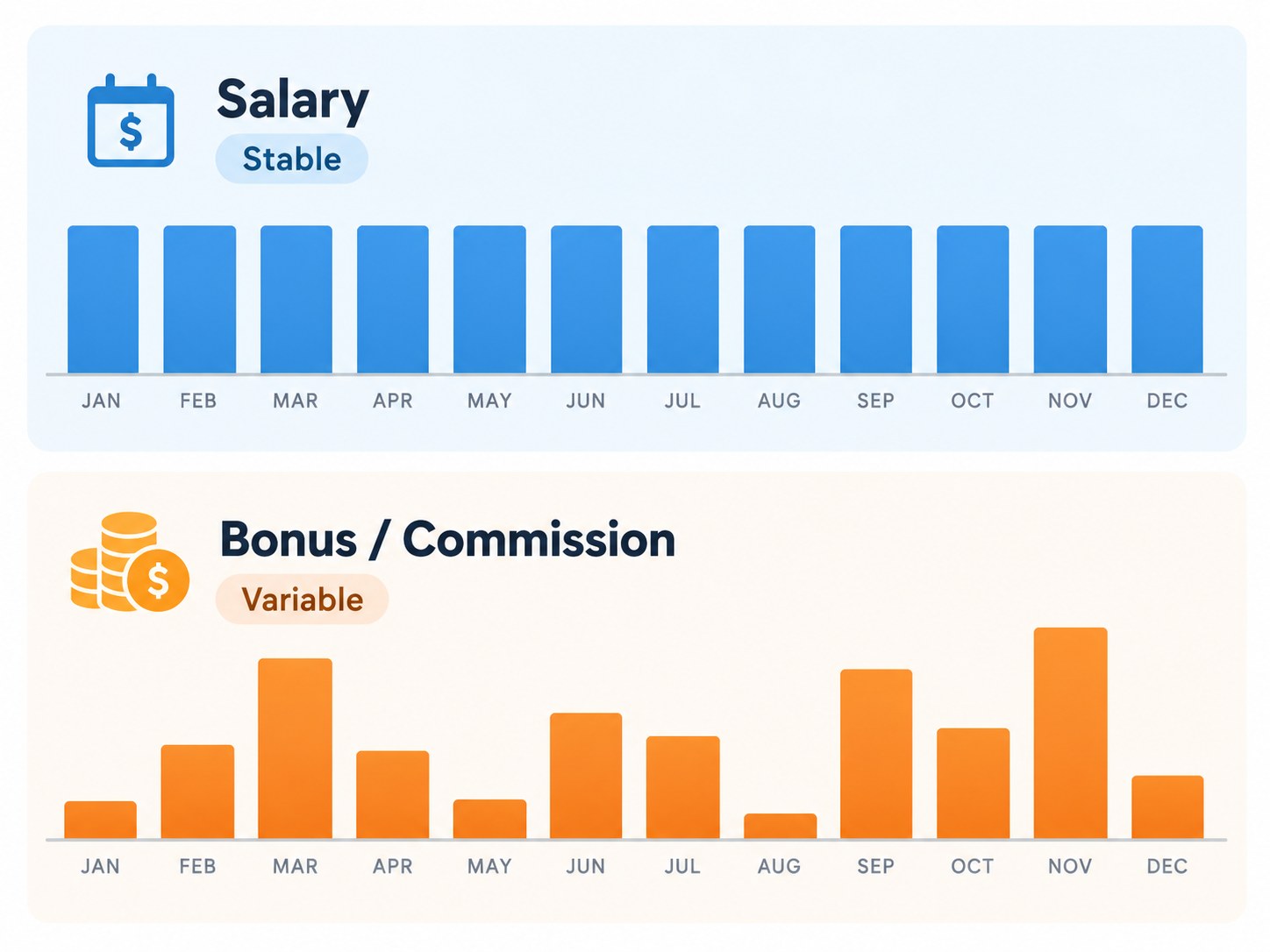
Even when you are an employee, the lender may treat different parts of your pay differently. Your income could include base salary, guaranteed hourly income, overtime, bonuses, commissions, shift premiums or contract income.
Bonuses and commissions are particularly important because they are not always guaranteed. If you want the bank to include bonus or commission income, lenders will commonly want to see that you have received it consistently for two years. The lender can then average the amount received over those two years rather than simply using your latest or highest year.
If you ever lose your job or your employment income suddenly changes, read our article on what happens to your mortgage after a job loss.
Self-Employed Income
A self-employed borrower still normally files a T1 General and receives a Notice of Assessment. The difference is that business income is reported within the personal tax return.

For a sole proprietor, for example, business income and expenses may appear through the T2125 Statement of Business or Professional Activities. This matters because a self-employed person can have significant business revenue while also having legitimate business expenses that reduce taxable income.
For example, if the business generates $128,000 of income but the borrower writes off 80% through legitimate business expenses, only about $25,600 remains as net business income. For a traditionally qualified mortgage, that lower number may be the income the lender starts with when determining how much the borrower earns for mortgage purposes. If you are self-employed and also buying with less than 20% down, the rules can become even more important because mortgage-insurance requirements come into play. Read our article on high-ratio mortgages.
Why do two years matter? For traditional self-employed qualification, lenders commonly want to see a history of income rather than relying on a single strong year. Two years of tax documentation is a common benchmark, and the lender may look at both years to determine what level of income appears reasonable and sustainable.
What If You Recently Became Self-Employed?
Suppose you worked as an electrician for eight years and then opened your own electrical business six months ago. That is very different from working as an electrician and then suddenly opening a restaurant.
In the first example, you have moved from employment to self-employment while remaining in the same line of work. There are lenders and programs that may consider your previous experience, training, contracts, current business activity, credit history and overall financial position when reviewing the application.
Traditional AAA lenders generally prefer consistency. Changing employers, changing occupations or moving from salaried employment into self-employment gives the underwriter another element to assess. It is not necessarily a deal-breaker, but it can make the income story more complicated.
For borrowers who are also new to Canada, lenders may have additional requirements around credit history and documentation. Read our article on mortgage challenges for non-Canadians.
What Is Stated Income?
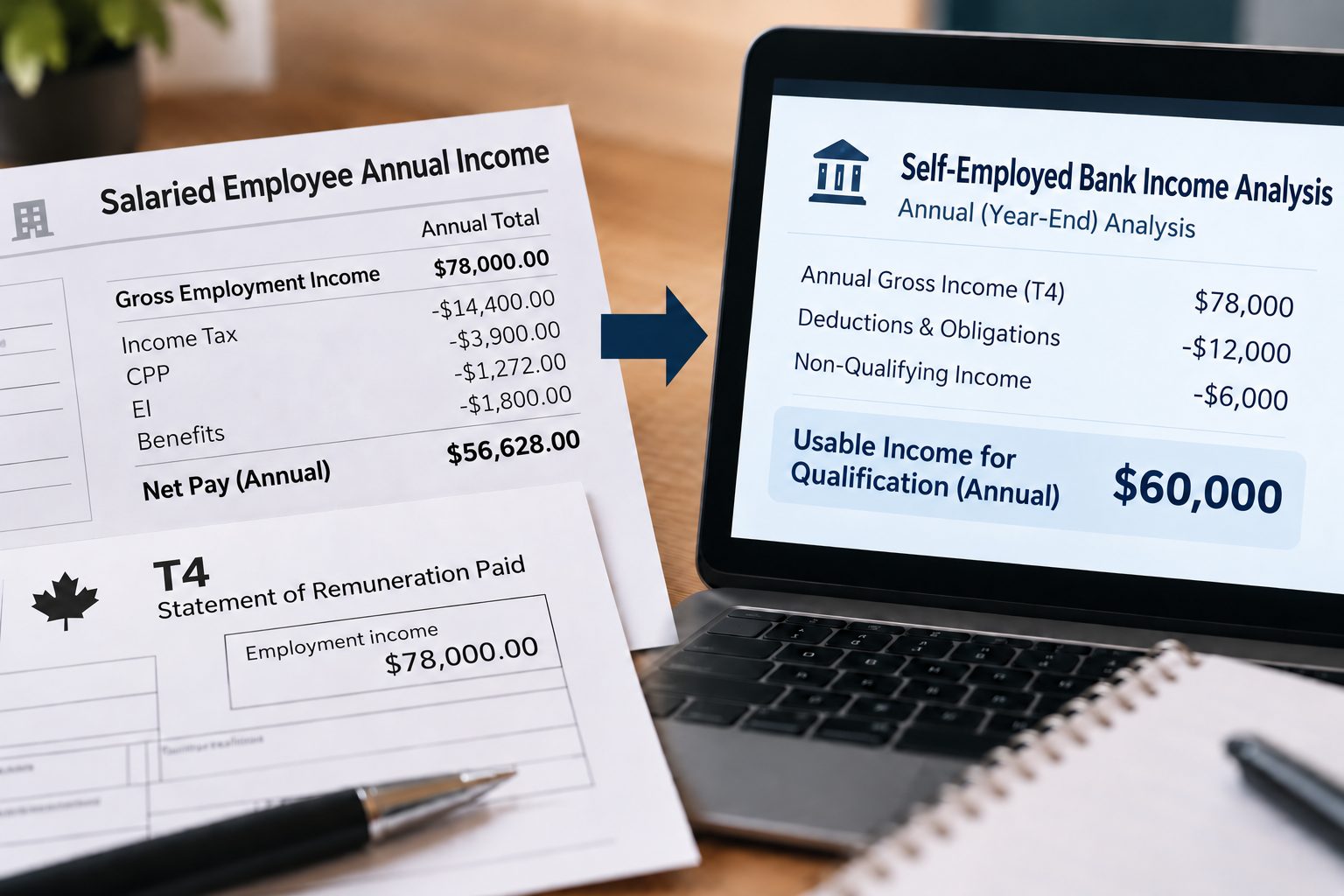
The term stated income is commonly used in the mortgage industry for self-employed borrowers whose traditional tax documents do not fully reflect the income their business is generating.
Depending on the lender and program, supporting documents can include personal or business bank statements, invoices, contracts, business records and evidence showing how long the business has operated. Some programs may review approximately 12 months of bank statements, although documentation requirements vary from lender to lender.
Salaried vs. Self-Employed vs. Stated Income
| Salaried | Self-Employed | Stated Income | |
|---|---|---|---|
| T4 needed | Yes | No | No |
| T1 / NOA needed | Depends | Almost always | No |
| 2-year history | Usually not for salary | Yes | Depends |
| Bank statements | Usually not for income | Sometimes | Yes |
| Income verification | Easiest | More detailed | Alternative documentation |
| Rate access | Widest / lowest potential | Prime rates may still be available | Often higher |
The chart is a general comparison only. Individual lender policies and the strength of the entire mortgage application can change the result. Not every province has identical mortgage-related laws and housing policies, and provincial rules can affect parts of the mortgage process. See how that could matter in our article on mortgage rules in Québec under the Parti Québécois.
Alternative Bank Solutions
Alternative or stated-income qualification can provide options for borrowers who do not fit traditional income-verification rules, but there can be a trade-off. If a traditional lender will not use enough of your income, that does not always mean the mortgage is impossible. You can also read more about private lender options.
The lender may look more closely at your credit score, the amount of equity in the property, the loan-to-value, the history of the business, the property itself and the reasonableness of the income being used. The mortgage rate may also be higher than it would be for a straightforward traditionally documented borrower, and the maximum loan-to-value may be lower.
In other words, all of these factors work together. A borrower with excellent credit, substantial equity and a long-established business may be viewed very differently from someone with weaker credit, limited equity and a newly established business.
Corporations are different. If you own an incorporated business, the analysis can become more complicated because your personal income and your corporation’s income are not necessarily the same thing. Corporate income, retained earnings, dividends and other corporate considerations deserve their own article, so we will leave that discussion for another day.

Other Income That Could Be Approved
Your mortgage application does not necessarily depend only on the income from your main job. Lenders may also be able to consider other sources of income such as part-time employment, pension income, child support, spousal support, Canada Child Benefit and certain other recurring income.
Once again, the question is not simply whether you receive the money. The lender needs to determine whether it can be verified, whether it is stable and whether it is expected to continue. If you move from one province to another, your income may stay the same while your housing and living costs change. Our article on interprovincial trade barriers and mortgages looks at how provincial differences can affect the broader picture.
Part-Time and Second-Job Income
If you earn extra money through a part-time or second job and report that income, it can potentially help you qualify. The lender will usually look at how consistent that income has been.
If the hours are guaranteed, the income may be relatively straightforward to use. If the hours fluctuate, the lender may want a longer history and may average the income, similar to the way it treats overtime or commission income.
For example, someone who has consistently earned between $12,000 and $15,000 per year from a second job for several years will generally present a stronger income history than someone who started that job only a few months ago.
Child and Spousal Support
Child support or spousal support may also be usable as contributory income. Ideally, you want clear documentation confirming the amount you are entitled to receive, together with evidence that the payments are actually being made.

Depending on the lender, this could include a separation agreement, divorce agreement, court order, tax documentation or bank statements showing the recurring deposits. The lender may also consider how long those payments are expected to continue.
If you have been divorced or separated for several years and can no longer locate the original separation agreement, some lenders may still consider the income if you can provide bank statements showing a consistent history of the support payments being deposited into your account.
Pension Income
Pension income can often be used for mortgage qualification, whether it comes from an employer pension or a government source such as CPP or OAS. For someone living on a fixed retirement income, monthly debt payments can have a major effect on qualification. If debt payments are the problem, read our article on refinancing a mortgage for debt consolidation.
The simplest situation is when you have formal pension documentation such as a T4A, Notice of Assessment or pension statement showing the amount received. If that documentation is not readily available, some lenders may accept evidence of recurring pension deposits verified through your bank account statements.
Canada Child Benefit
Canada Child Benefit may sometimes be included in qualifying income, but lenders and mortgage insurers can have their own rules about whether they will use it, how much they will use and how long the benefit must reasonably be expected to continue.
The most straightforward documentation is the Canada Child Benefit Notice issued by the government. If that is not available, some lenders may accept evidence of the recurring direct deposit, verified with bank account statements.
The important point is that there is no single rule that applies to every lender. If childcare benefits are important to your qualification, your mortgage professional should verify the policy of the lender being considered.
Contributory Income
Some lenders may also consider what is often referred to as contributory income.
For example, you may own or be purchasing a home and have someone who is not related to you living in one of the rooms and paying you rent each month. In certain circumstances, a lender may allow some of that income to help support the mortgage application.
The exact treatment depends on the lender, the property and the documentation available. It should not be assumed that every lender will use room-rental or boarder income in the same way.
Rental Income
Rental income can also be used when qualifying for a mortgage. That can apply when you are purchasing a rental property and either will not live in it, or you will occupy one portion and rent another portion to tenants.
However, rental-income calculations can become much more complicated because lenders do not all treat rental income the same way. Some use a percentage of the rent, while others use different rental-offset or debt-service calculations.
That subject deserves its own article, so we will not get deeply into rental-income calculations here. If you are considering using equity from an existing property before buying another one, read our article on mortgage refinancing.
Undeclared Income
Traditional lenders generally want income that can be independently verified through acceptable documentation. If you receive additional income but do not report it through the normal tax system, you should not assume that a traditional bank will simply accept it because you tell them you earn it.
Alternative or stated-income programs may sometimes recognize legitimate self-employed cash flow that traditional tax documents do not fully reflect. The documentation and method used to establish that income will depend on the particular lender and program.
The Bottom Line
When applying for a mortgage, the important question is not simply: How much money do you make?
The more important question is: How much of your income can the lender verify, accept and actually use?
Strong income is only one part of affordability. Mortgage rates can still rise when the economy is doing well, so borrowers should also consider how higher rates could affect qualification and future payments. Read more about why mortgage rates may rise in a strong economy.
A salaried borrower, contractor and self-employed borrower can earn exactly the same amount and qualify for very different mortgage amounts. Even after a lender accepts your income, it still has to fit the GDS and TDS ratios used in the mortgage stress test. That is why understanding your income type—and choosing a lender whose guidelines fit that income—can make such a significant difference to your mortgage approval.