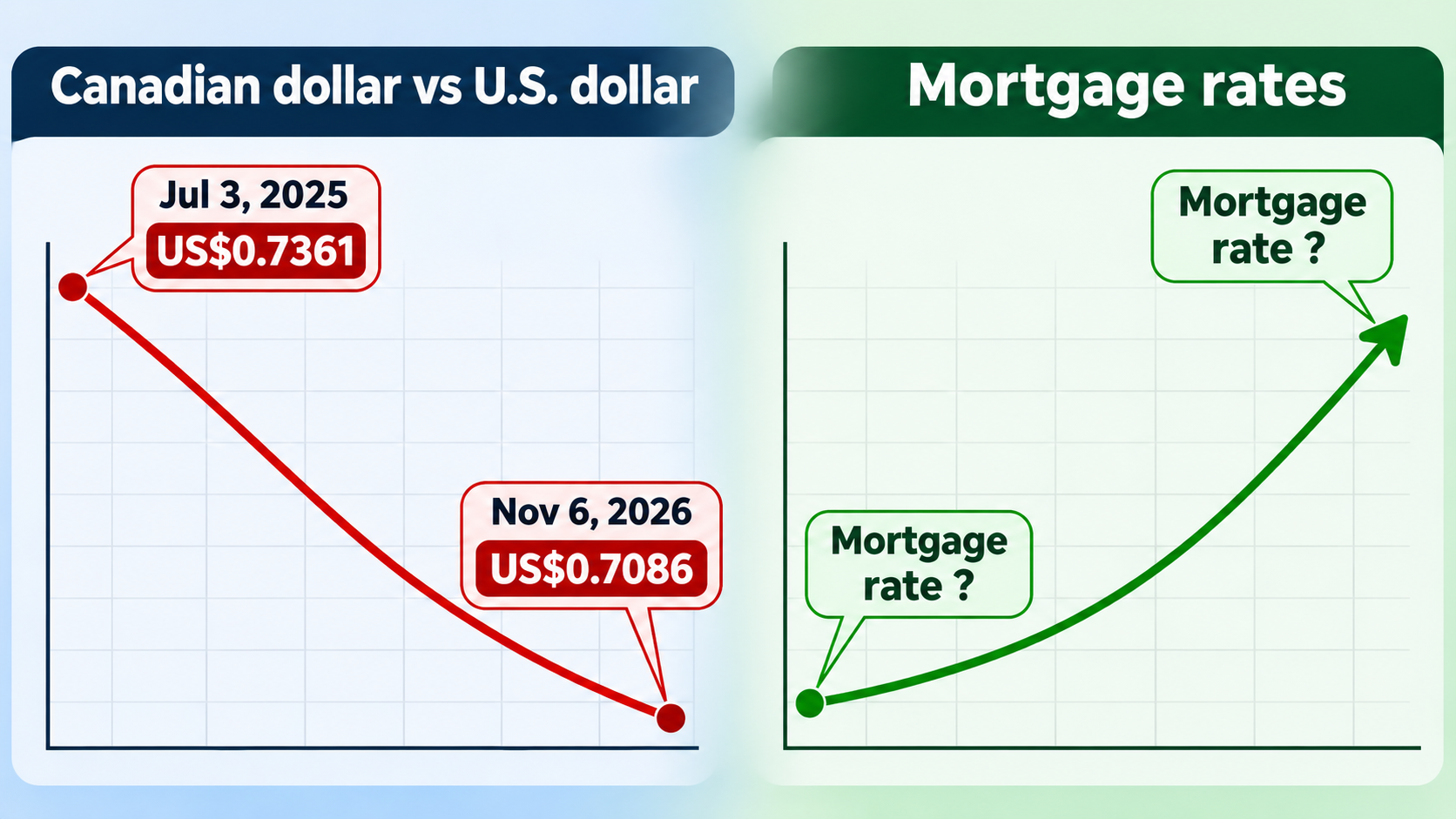
A weaker Canadian dollar and softer employment could pull mortgage-rate expectations in different directions.
What Happened to the Dollar?
On October 9, the Canadian dollar touched an 18-month low at approximately 69.94 U.S. cents, according to Reuters’ October 9 report. On November 6, it fell about 0.8% against the U.S. dollar, its steepest one-day decline in nine months, trading near 70.78 U.S. cents late in the day. The Bank of Canada exchange figures also show the loonie weakening between November 5 and 6.
The same day, Statistics Canada reported that employment edged down by 4,700 jobs in October and unemployment rose to 6.7%. That followed larger employment declines in August and September. Our related article examines U.S. trade tensions and employment, without attributing those losses to tariffs. Read the official October employment report.
Reuters also pointed to stronger U.S. jobs data and global market volatility. For another cross-border perspective, see Canada-U.S. trade and mortgage rates. The question for Ontario homeowners is whether a weak currency and weak employment can exert competing pressures on borrowing costs.
How a Weaker Dollar Can Affect Mortgage Rates

When Canadian businesses buy goods priced in U.S. dollars, a weaker loonie can make purchases costlier in Canadian dollars. This may affect imported building materials, equipment and household products. Businesses do not necessarily pass every exchange-rate change to customers.
The Bank of Canada already expects higher import costs to contribute to inflation through 2027, partly because of earlier currency depreciation, tariffs and energy prices. Its October monetary policy outlook explains these pressures. For more context, see how tariffs affect mortgage rates. One day’s currency decline does not establish how much inflation, if any, will result.
Could Weak Employment Lower Rate Expectations?
A weakening labour market may give the Bank of Canada reason to be cautious about rate increases. Borrowers may find that surprising when import prices threaten inflation. Both pressures can exist at the same time.
The Bank raised its overnight target to 2.50% on October 28, before the latest employment report. Reuters reported that markets lowered their estimate of a December rate increase after the new data. That market reaction is not a forecast of the Bank’s decision.

A central bank must consider inflation and economic conditions, rather than defend a particular exchange rate. Weaker employment may reduce demand, while a weaker currency may push some prices higher. It is unknown which influence will matter more at future decisions.
What About Fixed and Variable Mortgages?

Variable mortgage rates usually follow lenders’ applicable prime rates, which tend to respond to Bank of Canada monetary policy. The Canadian dollar itself does not directly reset your rate or payment. Your mortgage contract determines how rate changes affect you.
New fixed mortgage rates respond more to changes in Canadian bond yields and lenders’ funding costs. Reuters reported that Canada’s two-year government bond yield actually fell on November 6. That move is not proof that five-year mortgage offers decreased, while existing fixed contracts generally retain their rates until renewal.
What Should Ontario Borrowers Do?
If employment has become less secure, focus on income stability and reserves before taking on a larger obligation. Borrowers facing layoffs can read mortgage options after losing employment. For another possible qualification risk, see U.S. tariffs and mortgage eligibility. Mortgage pricing, future exchange rates and the Bank’s next decision remain uncertain.
The November 6 currency slide adds another economic crosscurrent; it does not confirm a mortgage-rate change. Ontario homeowners should watch Bank decisions, bond yields and real lender offers.