A 40-year mortgage could lower monthly payments, while 90% refinancing could unlock substantially more home equity—but neither change will happen unless Ottawa accepts the mortgage brokers’ proposals.
Table of Contents
What Exactly Do Mortgage Brokers Want Changed?
On October 26, 2026, the Canadian Mortgage Brokers Association (CMBA) urged Ottawa to loosen mortgage restrictions that it argues prevent some Canadians from purchasing homes or accessing their equity. The association presented its requests in the October 26 CMBA policy announcement. These are industry proposals, not changes to the mortgage rules in force today.
First, the CMBA wants 30-year amortizations for all eligible insured mortgages and up to 40 years for qualifying first-time buyers. Second, it proposes insured refinancing up to 90% loan-to-value for financially qualified homeowners. Third, it seeks a national framework, developed with provinces, offering government-supported, repayable down-payment loans.
These are three distinct issues: managing a monthly payment, accessing home equity and saving for a purchase. So what would they actually mean to an Ontario household?
Would a 40-Year Mortgage Really Make a Home More Affordable?
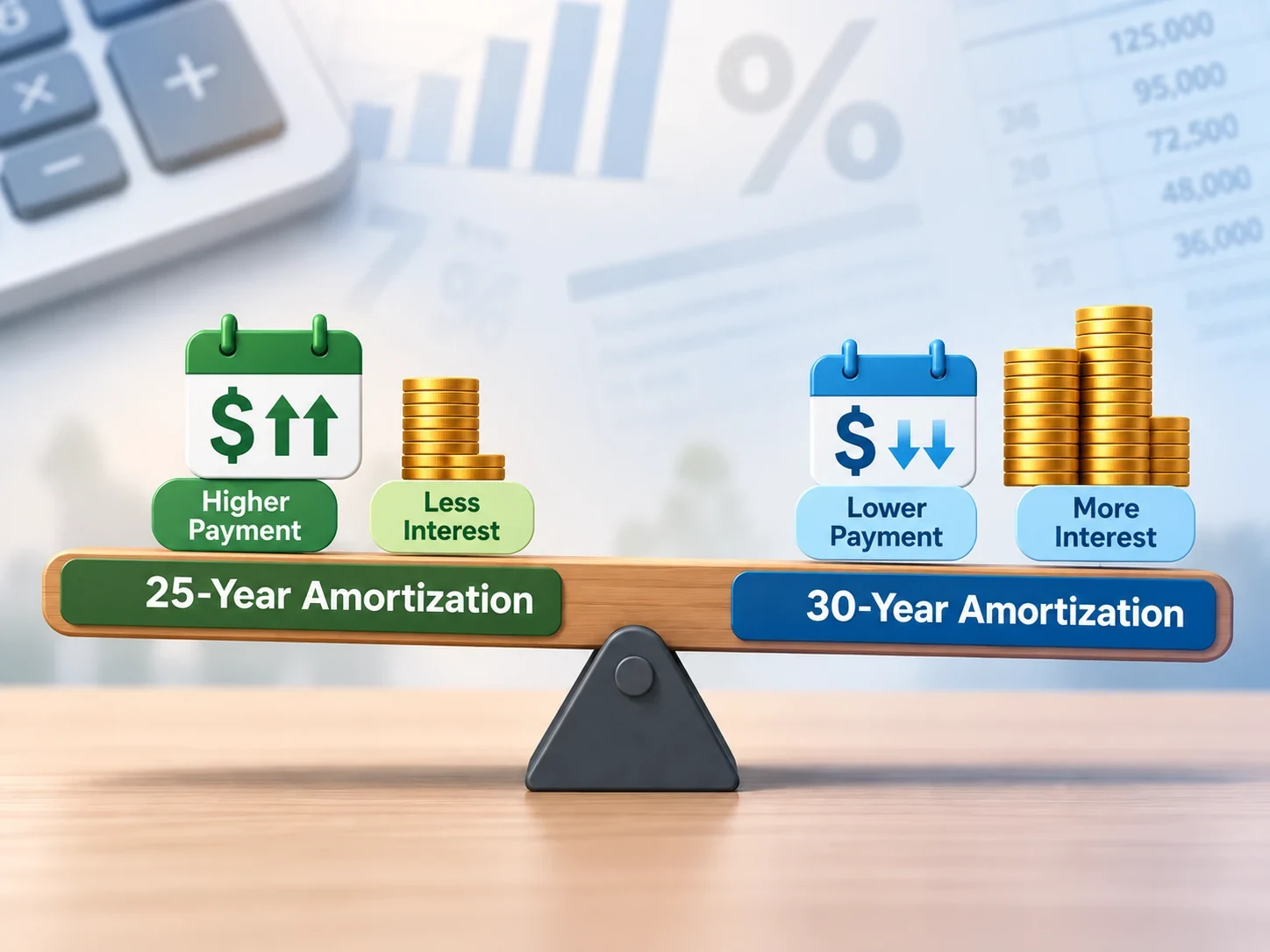
A 40-year amortization generally lowers the required payment compared with 30 years at the same rate. It could help some buyers manage cash flow and potentially affect qualification, depending on any future lending rules. However, affording a monthly payment and paying off a mortgage economically are different questions.
Take a $500,000 mortgage at 4.50%. Here is an illustrative comparison with monthly payments and an unchanged rate throughout:
| $500,000 mortgage at 4.50% | 30 years | 40 years |
|---|---|---|
| Monthly payment | $2,521 | $2,234 |
| Balance after five years | $455,502 | $474,727 |
| Total interest | $407,588 | $572,539 |
Illustrative Canadian fixed-rate calculation using semi-annual compounding, monthly payments, no prepayments and 4.50% unchanged over 30 or 40 years. Excludes insurance premiums and fees. Actual rates normally change at renewal; 40-year insured amortizations have not been approved.
The 40-year option would save roughly $287 a month, but cost nearly $165,000 more in interest over the full repayment period under these assumptions. More debt would also remain after five years. Lower payments can help, but they are not the same as lower total borrowing costs.

What Could 90% Refinancing Change for Ontario Homeowners?
For homeowners with high-interest debt, this could be the most consequential idea. Conventional refinancing is generally limited to 80% of a home’s appraised value, as outlined in the federal home equity borrowing guidance. The CMBA wants broader insured refinancing at up to 90% for qualified borrowers, which could expand potential debt-consolidation options if Ottawa changes the rules.
Consider an Ontario home worth $800,000. Eighty per cent is $640,000; 90% is $720,000—a theoretical $80,000 increase in maximum secured borrowing. It would not mean $80,000 automatically available in cash: existing mortgages, income, credit, insurance premiums and lender approval would still matter.
And shifting credit-card debt into a mortgage can stretch repayment over decades. Before doing so, compare payments, total interest, premiums and costs. See how mortgage refinancing for debt consolidation works under current options.
Could Repayable Down-Payment Assistance Help First-Time Buyers?
The CMBA is also proposing a government-backed down-payment loan framework with the provinces. It is aimed at buyers who may be able to carry mortgage payments but have difficulty saving the upfront cash. This would be repayable assistance, not a grant or gift.

Who would qualify, the repayment terms and how lenders would count the additional debt are all unknown. Down-payment assistance alone does not guarantee mortgage approval or long-term affordability.
What Mortgage Rules Are Already in Place?
Thirty-year insured amortizations already exist for eligible first-time buyers and purchasers of new builds under rules effective December 15, 2024. Other insured purchases generally remain subject to a 25-year maximum. Those are the existing December 2024 federal reforms, not the CMBA’s new 40-year proposal.
A narrower 90% insured refinance program also exists for eligible homeowners adding secondary suites. CMHC limits the additional money to eligible construction costs; it is not general-purpose 90% cash-out refinancing. Read the CMHC secondary-suite insured refinance requirements.
What Should Ontario Homebuyers and Homeowners Do Now?
Ottawa has not announced that it will adopt these proposals. Eligibility, insurance pricing and implementation dates—if reforms ever pass—remain unknown. Buyers should plan based on mortgage rules available today, rather than assume they will qualify for 40 years or a 90% refinance.
These ideas could open doors for some people, but easier qualification can also mean carrying more debt for longer. The real question is not simply “Could I get approved?” It is “What can I afford, and what will it cost over time?”