Mortgage Stress Test
Canada’s mortgage stress test is a way of checking whether you could still carry your mortgage if interest rates were higher than the rate you are actually being offered.
Table of Contents
Qualifying Rate Explained
GDS Defined
TDS Defined
Example of a Stress Test
How Your Budget Fits
What Higher Rates Change
Refinancing and the Stress Test
Renewals and the Stress Test
What Matters Most
In practical mortgage underwriting, alongside measures such as loan-to-value (LTV), the stress test works through two calculations: GDS and TDS.
The lender does not simply look at your mortgage payment at the rate you will actually pay. It calculates a payment using the applicable qualifying rate, then plugs that higher payment into your debt-service ratios, which can reduce how much mortgage you qualify for.
That is why someone can be perfectly comfortable with the real monthly mortgage payment and still fail to qualify for the mortgage.
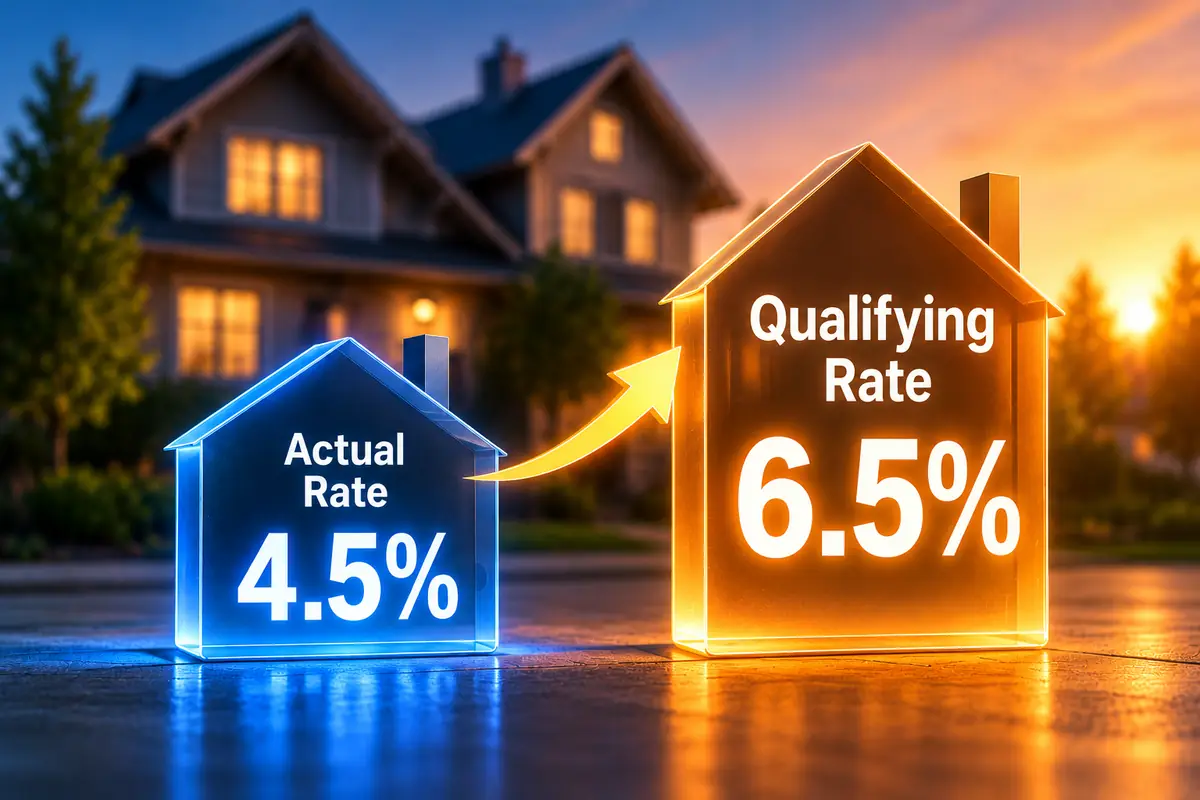
Qualifying Rate
For federally regulated uninsured mortgages, the current minimum qualifying rate is the greater of:
- 5.25%, or
- your mortgage contract rate plus 2 percentage points.
CMHC uses the same greater-of calculation in its insured mortgage programs.
So if your mortgage rate is 4.50%, the lender generally tests the mortgage payment at 6.50%. If your mortgage rate were 2.75%, the 5.25% floor would be higher than 4.75%, so 5.25% would be used.
Source: OSFI — Minimum Qualifying Rate | CMHC — Calculating GDS/TDS
GDS
GDS stands for Gross Debt Service ratio. It measures how much of your gross income is required to cover the basic carrying costs of the home.

For CMHC-insured mortgages, the standard maximum GDS threshold is currently 39%.
For a condominium, 50% of the condo fees are generally included in the CMHC GDS calculation. Property taxes and heating costs also count even though they are not part of the mortgage payment itself.
This is one reason two people asking for the exact same mortgage amount can qualify differently. A property with high taxes or high condo fees can produce a higher GDS even when the mortgage itself is identical.
TDS
TDS stands for Total Debt Service ratio. It starts with the housing costs used in GDS and then adds the borrower’s other debt obligations.

For CMHC-insured mortgages, the standard maximum TDS threshold is currently 44%.
Depending on the lender and the debt, TDS can include obligations such as:
- car loans or leases
- credit-card obligations
- lines of credit
- personal loans
- student loans
- support payments and other recurring obligations
The exact treatment of a particular debt can vary by lender and mortgage program.
Source: Financial Consumer Agency of Canada — Preparing to Get a Mortgage | FSRA — Mortgage Application Process
Example
This is the part that causes the most confusion.
Suppose a household earns $100,000 per year, or about $8,333 per month before tax.
They want a $400,000 mortgage amortized over 25 years at 4.50%. The actual mortgage payment is roughly $2,214 per month. But if the qualifying rate is 6.50%, the payment used for the stress test is roughly $2,679 per month.
Assume the property also has $400 per month in property taxes and $150 per month in heating costs.
That borrower is just under the 39% CMHC GDS threshold.
Now suppose the borrower also has a $400 monthly car payment and another $150 per month of qualifying debt obligations. Those debts do not change the GDS — but they do change the TDS.
The borrower can therefore be under the GDS limit but over the TDS limit.
This is why paying off a car loan or reducing another debt can sometimes make a surprisingly large difference to mortgage qualification even though nothing about the house has changed.

Your Budget
Debt-service ratios are underwriting calculations. They are not a complete household budget.
Groceries, childcare, transportation, insurance, cell-phone bills and many other everyday costs are generally not included in the simple GDS/TDS formulas in the same way that mortgage payments and debt obligations are.
FSRA specifically cautions that qualifying under debt-service ratios does not necessarily mean a mortgage is affordable for a particular household. Your actual monthly budget may tell a different story.
Higher Rates
The stress test does not directly reduce your income. When mortgage rates rise, it increases the mortgage payment that the lender uses in the qualification calculation.
A higher qualifying payment pushes GDS and TDS upward. Once one of those ratios becomes too high for the lender or mortgage program, the requested mortgage may no longer fit.
This creates an important relationship:
The reverse can also happen. Lower debt obligations, more qualifying income, a smaller mortgage, lower property taxes or lower condo fees can reduce the ratios.
Refinancing

The stress test can be especially important when refinancing a mortgage.
A homeowner may have plenty of equity according to the property’s loan-to-value ratio (LTV), but equity alone does not necessarily mean the borrower qualifies for the mortgage amount requested.
The lender can still ask whether the borrower’s income supports the new mortgage payment after applying its qualifying rate and debt-service calculations.
This is particularly important when someone is refinancing for debt consolidation. Paying off outside debt with the refinance may improve the final TDS calculation, but the lender still has to determine which debts are being paid, how they will be treated and whether the new mortgage fits its underwriting rules.
Renewals
The stress-test rules have an important renewal exception.
OSFI no longer prescribes the minimum qualifying rate for certain uninsured straight switches from one federally regulated lender to another at renewal when there is no increase in the loan amount or remaining amortization period.
There are also rules allowing qualifying insured borrowers to switch lenders at renewal without being required under the federal mortgage-insurance rules to requalify using the minimum qualifying rate.
That means a borrower should not assume that simply changing lenders at renewal automatically requires the same stress test that would apply to a new mortgage or refinance.
Source: OSFI — Uninsured Mortgage Straight Switches | Department of Finance Canada — Mortgage Renewal and Switching
What Matters
People often begin a mortgage conversation by asking:
“What interest rate can I get?”
But the rate you receive and the rate used to qualify you may be different.
For qualification, the more useful questions are:
“What payment will the lender use for the stress test, and what will my GDS and TDS be after that payment is included?”
Those numbers can determine how much mortgage you qualify for long before the first real mortgage payment is ever made.