A qualifying apartment buyer could need less equity, but the building’s income and the borrower’s finances will still determine whether the purchase works.
What Has Ottawa Announced?
On November 5, 2026, Finance Canada published parameters for eligible five-to-50-unit properties. They cover construction, purchase, refinance and renewal. Lenders can submit insurance applications from February 1, 2027; the announcement does not make financing available today.
The federal mortgage insurance parameters set ceilings of 90% loan-to-value and 50-year amortization for new construction, versus 85% and 40 years for other transactions. There is no owner-occupancy requirement or property-value cap. Read the official federal insurance parameters.
Under the federal eligibility criteria, units must be self-contained, with cooking, sleeping and bathroom facilities, under one legal title or ownership structure. Separately titled properties cannot be bundled to meet the unit threshold.
Could a Sixplex Need Less Cash?
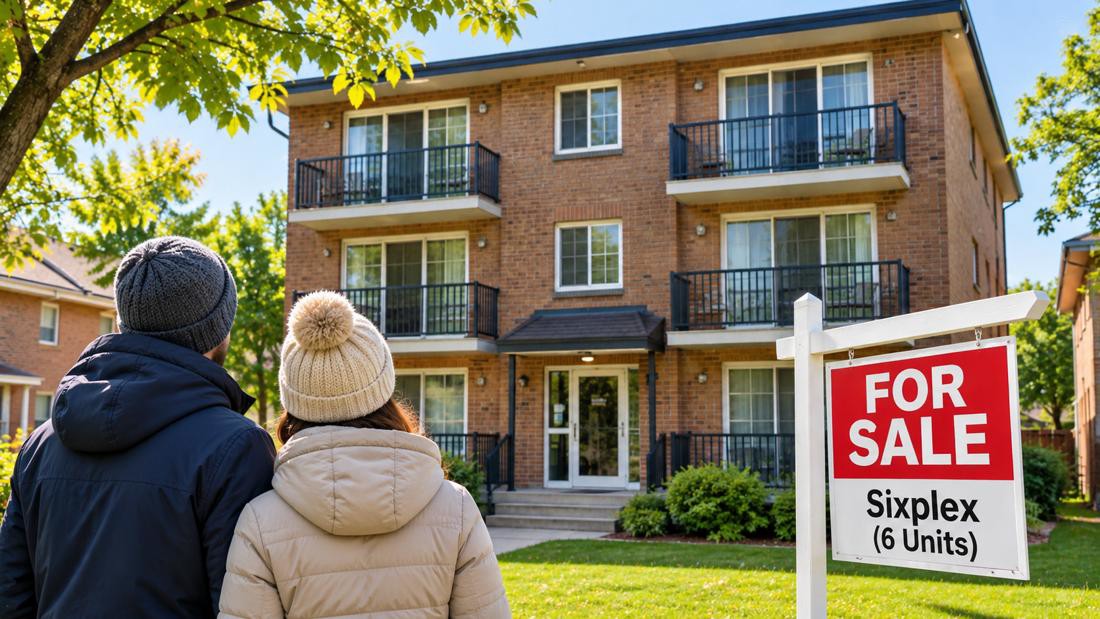
For example, assume an eligible existing sixplex costs $450,000, and the accepted lending value is also $450,000. At 85% LTV, the mathematical mortgage ceiling is $382,500, leaving $67,500 toward the price. That excludes insurance costs, closing costs and reserves.
In another example, compare that with a 65% financing offer on the same purchase: a $292,500 mortgage and $157,500 toward the price. The difference is $90,000 in initial equity. These are illustrations, not quotes.
It’s possible that higher permitted leverage could reduce the equity hurdle for a qualifying investment. It also increases the debt that rent must support. My guide to how loan-to-value works explains why the accepted value matters.
How Much Income Must the Building Produce?

The federal debt coverage requirements set minimum debt coverage at 1.15 for five-year terms and 1.10 for ten-year terms, calculated as net operating income divided by total debt service. Construction loans are exempt from the stated amortization and coverage requirements; insurers apply their own construction underwriting.
For example, assume accepted annual debt service is $36,000, a 1.15 ratio requires $41,400 in accepted annual net operating income. At 1.10, the arithmetic is $39,600. A rent roll alone does not establish either figure.
In another example, assume a sixplex collects $6,500 monthly, or $78,000 annually. That is gross rent. You still need operating expenses and the lender’s accepted adjustments before calculating net operating income. A large rent total can therefore leave less borrowing room than a buyer expects.
Net Worth?
The federal borrower eligibility requirements state that net worth must be at least 25% of the requested loan, with a $100,000 minimum, based on assets held in Canada.
For example, with the illustrative $382,500 loan, 25% is $95,625, so the $100,000 minimum applies. Net worth differs from cash available to close.
It’s possible that a longer amortization could ease scheduled payments at the same loan amount and rate. Repaying principal more slowly can also increase total interest if the loan runs longer. Neither the payment nor the total cost can be established without actual pricing.
What Should Buyers Check Next?
Before making an offer, assemble the rent roll, leases, operating expenses, title and zoning information, available equity and net-worth details. Request a property-specific assessment.
Participating lenders, insurer premiums and the terms available to your building still require product-level confirmation. It’s possible that this framework could widen financing options for some small-apartment buyers. Whether a sixplex becomes easier for you to buy depends on the approval and the cash flow together.