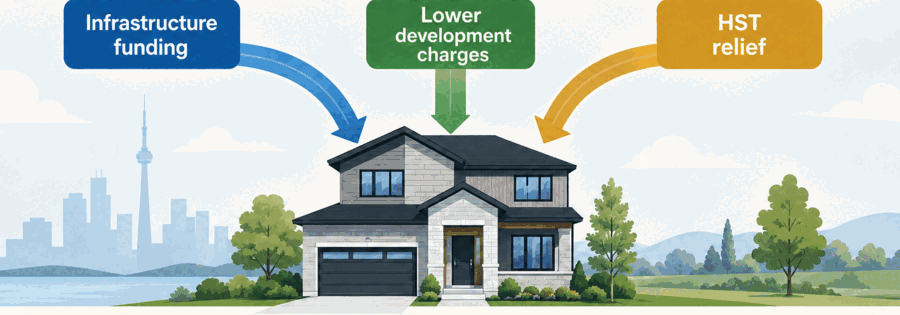
Ontario Government Could Reduce Some New Ontario Home Prices by Up to $200,000
The federal and Ontario governments have announced a new $1-billion infrastructure program to support housing construction in qualifying Ontario municipalities. In addition to expanded HST relief, the governments say their housing measures could reduce costs for purchasers by as much as $200,000.
Source: Government Announcement
That is a significant number—but it requires several important qualifications.
What Has the Government Announced?
Whenever a developer builds new housing, infrastructure such as water systems, sewers and roads must also be built. Somebody has to pay for it—either the municipality or the developer. If the developer pays, those costs are usually included in the prices charged to homebuyers.
Alternatively, a municipality may cover the cost, receive government funding to help pay for it or agree to charge a developer lower fees for such costs. The result could be lower house prices.
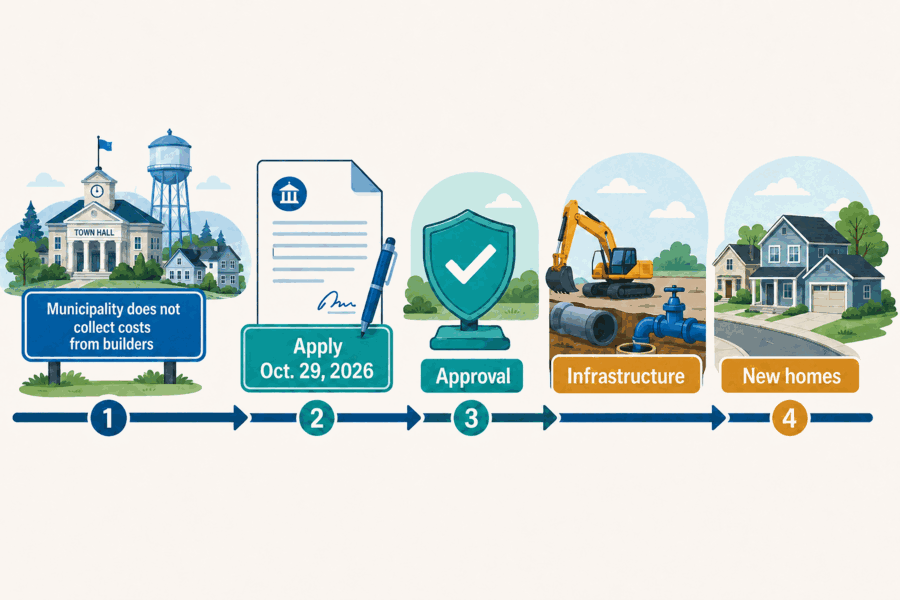
The new Non-Development Charge Municipalities Stream will help eligible Ontario municipalities pay for these costs to reduce developer expenses. The hope is that housing prices fall in eligible municipalities. This is a government funding program—not a change to mortgage legislation.
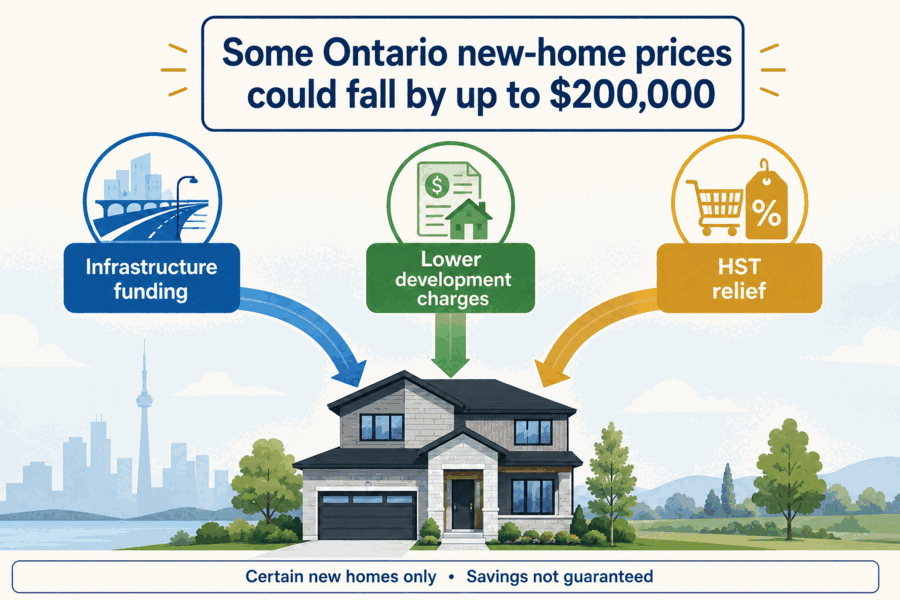
However, this government initiative could affect the mortgage application process.
How Probable are $200,000 lower prices?
The governments say their combined housing measures could reduce costs for homebuyers by up to $200,000 in certain jurisdictions. This does not mean every buyer will receive a $200,000 discount. The amount refers to the potential combined effect of several measures: infrastructure funding, reduced development charges and expanded HST relief.
The new $1-billion infrastructure program will not produce $200,000 in savings by itself.
Actual savings will depend on the municipality, infrastructure costs, applicable HST relief and whether reductions in development costs are reflected in the builder’s selling price.
Although this new government program could help lower house prices, government funding does not guarantee an equal one-to-one price reduction. Land values, labour, materials, local demand and the builder’s pricing decisions will continue to affect the final price.
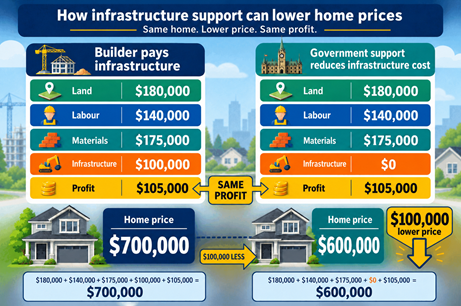
As the above chart shows, the builder makes exactly the same profit in both scenarios. The second home can be sold for less because government support reduces the infrastructure cost the builder has to pay.
Keep in mind that Canada–U.S. trade negotiations could affect the lumber industry if tariffs increase material prices. Housing construction costs could rise. The potential benefit applies to eligible new housing—not existing resale homes.
Which Municipalities?
The new funding stream is intended for Ontario municipalities that do not charge infrastructure costs to developers. It is not limited to Northern Ontario, although many potentially eligible communities are small, rural, remote or northern. The application period is scheduled to open on October 29, 2026. The government has not yet published a final list of municipalities or housing projects that will receive funding.
Why not All Cities?
It may not appear fair when viewed from the perspective of two homebuyers. One buyer faces higher house prices while another in a different municipality would benefit from lower prices due to government funding.
The governments could defend the arrangement noting that municipalities are not starting from the same financial position. Those that charge costs to developers already have a source of money for growth-related infrastructure. Municipalities that do not collect these charges—many of which are smaller or rural—may have a limited tax base, aging infrastructure and no development-charge revenue.
This new program is intended to address that disadvantage.
Municipalities that currently collect costs from developers have not been completely excluded. A separate Development Charge Reduction Program offers infrastructure funding to municipalities that reduce their charges and keep them lower for at least three years. More information about this specific program can be found here.
The policy is best understood as an incentive rather than equal treatment. The governments are encouraging municipalities to stop collecting costs from developers by offering infrastructure funding in return.
This example does not represent guaranteed savings. The mortgage difference would also depend on the buyer’s down payment and other financing details.
Expanded HST Relief
Expanded HST relief is separate from the new infrastructure stream. A qualifying purchaser of an eligible new home may receive additional tax relief, reducing the property’s effective cost. Buyers should confirm with their lawyer how any HST relief is being applied before relying on it.
What Could This Mean for Your Mortgage?
If these programs lead to lower new-home prices, some purchasers who could not previously qualify for a mortgage might now become eligible. Other buyers might qualify for a larger or more suitable home while keeping the mortgage within their approved limit.
Buyers could also explore communities who have received infrastructure funding, which may eventually contribute to lower new-home prices. However, buyers should not select a location based only on anticipated funding because savings are not guaranteed to be passed on by builders. The public can monitor Ontario’s Municipal Housing Infrastructure Program page for information about its funding streams and future announcements concerning participating municipalities and projects.
What Should You Confirm Before Purchasing?
Before relying on the anticipated savings, ask the builder, municipality, lawyer or mortgage professional to confirm:
- whether the municipality has applied and been approved for funding;
- whether the particular development benefits from the funded infrastructure;
- whether development-charge savings are reflected in the selling price;
- whether the property and purchaser qualify for expanded HST relief; and
- how the incentives are documented in the purchase agreement.
The announcement could eventually make some new Ontario homes more affordable and help certain purchasers qualify for smaller mortgages. Until municipalities and projects are approved, however, buyers should treat the potential savings as an opportunity to investigate—not money they are guaranteed to receive.
Source
Government of Canada—$1 billion to help non-development-charge municipalities build more homes